
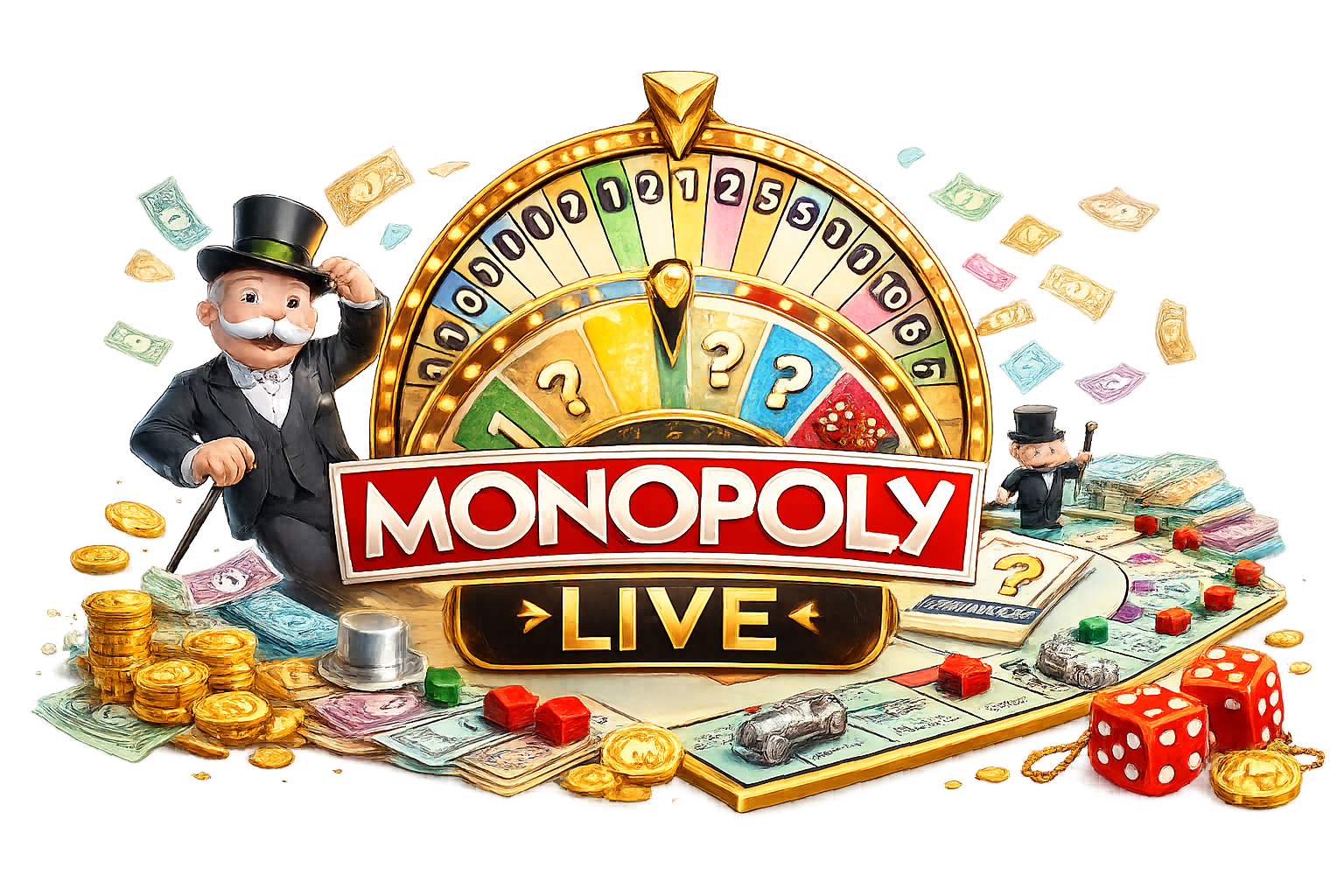
Monopoly Live Game Overview
Monopoly Live is a live casino game show developed by Evolution. The game combines a traditional casino wheel format with elements from the Monopoly board game. Instead of reels and paylines, the gameplay revolves around a large money wheel operated in a live studio environment with a human host. Players place bets on segments of the wheel and watch the spin unfold in real time.
At Jaak Casino, Monopoly Live is presented as part of the live casino section where the game is streamed directly from Evolution’s studio. The interface combines a video broadcast with a betting panel where players can choose which wheel segments to support before each spin begins. Because the outcome is determined by the physical wheel in the studio, the pacing and presentation of the game differ from automated slots or RNG table games.
The design of Monopoly Live is built around a game-show atmosphere. The host interacts with the audience, explains bonus rounds when they occur, and guides the session between spins. This structure creates a different rhythm compared with slot games. Instead of rapid automated spins, the game progresses in rounds that include betting time, the spin itself and the result announcement.

Core Gameplay Structure
The main mechanic of Monopoly Live is the large vertical wheel positioned in the studio. The wheel is divided into a set of segments that correspond to betting options. Before each round begins, players select which segment they want to bet on. When betting closes, the host spins the wheel and the pointer determines the winning segment.
Most segments on the wheel represent fixed multipliers. If the pointer lands on one of these numbers, players who placed bets on that segment receive the corresponding payout. The majority of spins resolve through these standard segments, which form the base layer of the game’s outcome distribution.
However, the wheel also contains special segments that trigger bonus rounds. These include the 2 Rolls and 4 Rolls segments. When the wheel lands on one of these spaces, the game transitions into a Monopoly-themed bonus feature where a digital board appears on screen. A character token then moves across the board according to dice rolls.
This structure means that Monopoly Live distributes outcomes across two main layers. The first layer consists of standard wheel results where a multiplier is applied directly to the bet. The second layer involves bonus rounds that can generate larger payouts depending on board progression and multipliers encountered during movement.
Because of this layered design, the experience of the game often alternates between ordinary wheel spins and occasional feature rounds that change the visual environment of the studio broadcast.
Evolution Live Studio Environment
Monopoly Live is filmed in Evolution’s dedicated live casino studio. The studio is designed to resemble a television game show set, with lighting, large displays and animated graphics that integrate the Monopoly theme into the broadcast. The host stands beside the wheel and controls the pace of each round.
The live format introduces a presentation style that differs from purely digital games. Instead of a computer-generated spin sequence, the wheel is physically spun in the studio and captured by multiple cameras. This creates a more theatrical presentation where the spin itself becomes part of the entertainment.
While the wheel outcome is determined by physical motion, the digital elements of the game such as bonus rounds and board movement are generated through certified software systems. This combination of physical mechanics and digital game layers is typical for live casino game shows developed by Evolution.
From a gameplay perspective, the studio environment primarily affects pacing and presentation rather than the underlying return structure. The mathematical model of the game remains fixed regardless of how the broadcast is viewed.
Wheel Segments and Betting Options
The betting interface in Monopoly Live presents several options corresponding to segments of the wheel. These segments include standard multipliers such as 1, 2, 5, and 10, as well as the two bonus triggers. Each betting option has a different probability of appearing on the wheel, which influences the associated payout level.
Segments with lower multipliers appear more frequently on the wheel, creating a base layer of smaller outcomes. Higher multipliers and bonus triggers appear less often but can generate more visible returns when they occur. This distribution ensures that the wheel produces a mixture of ordinary results and occasional feature activations.
The presence of bonus segments is what distinguishes Monopoly Live from traditional money wheel games. When the wheel lands on 2 Rolls or 4 Rolls, the gameplay moves to the Monopoly board where multipliers and additional movement can influence the final outcome. These bonus rounds introduce variability into the session without changing the overall probability structure of the wheel itself.
Wheel Segments and Payout Structure
| Segment | Base Payout | Game Function | Frequency Behaviour |
|---|---|---|---|
| 1 | 1x | Base wheel segment | Highest frequency outcome |
| 2 | 2x | Standard multiplier segment | Moderate frequency |
| 5 | 5x | Higher multiplier outcome | Lower frequency |
| 10 | 10x | Top base multiplier | Relatively rare |
| 2 Rolls | Bonus game | Triggers Monopoly board feature | Occasional trigger |
| 4 Rolls | Bonus game | Extended Monopoly board feature | Lowest frequency event |
RTP Structure in Monopoly Live
Return to Player in Monopoly Live follows the mathematical configuration defined by Evolution for the game show format. Unlike traditional slots, where RTP is calculated purely from a digital probability table, live casino game shows combine a physical outcome mechanism with a predefined payout structure. In Monopoly Live, the wheel itself determines which segment wins, while the payouts attached to those segments define the long-term return profile of the game.
The theoretical RTP of Monopoly Live depends on the betting segment selected by the player. Each segment represents a different probability and payout combination. Lower multipliers appear more frequently on the wheel and therefore carry a lower payout value. Higher multipliers and bonus segments appear less frequently but introduce larger potential outcomes.
From a mathematical perspective, the RTP calculation spreads the expected return across three main layers of results. The first layer consists of ordinary wheel segments such as 1, 2, 5, and 10. The second layer consists of bonus round triggers that move the game to the Monopoly board. The third layer includes high multiplier outcomes generated inside the bonus features themselves.
Because the distribution of these outcomes is uneven, short play sessions may vary significantly from the theoretical return. RTP reflects the expected average over a very large number of rounds rather than the result of a single session. A player may encounter multiple base wheel results in a row, or the wheel may trigger a bonus feature relatively quickly. Both outcomes exist within the same statistical model.
Wheel Probability Model
The probability structure of Monopoly Live is determined primarily by the physical layout of the wheel. Each segment occupies a specific number of positions, and the frequency of these positions influences how often that segment can appear during gameplay.
Segments with smaller multipliers occupy more positions on the wheel. This ensures that base results occur regularly and keeps the game progressing smoothly between feature triggers. Segments with larger multipliers occupy fewer positions, which naturally lowers their appearance frequency.
Bonus segments are distributed across the wheel in a way that maintains the pacing of the game show. They appear often enough to keep the broadcast dynamic but not so frequently that the base wheel becomes irrelevant. This balance allows the game to move between ordinary rounds and feature rounds without dramatically altering the rhythm of the session.
The presence of bonus triggers does not change the probability structure of the wheel itself. Instead, it adds an additional outcome layer that can produce larger multiplier events when the feature activates.
RNG Elements Inside Bonus Rounds
Although the wheel spin itself is determined physically, certain parts of the Monopoly Live bonus features rely on certified random number generation. When a bonus round begins, the movement of the character token across the Monopoly board is generated digitally. Dice rolls, board progression and multiplier outcomes are determined by software systems designed to meet regulatory requirements.
This hybrid structure is typical for modern live casino game shows. The initial trigger event comes from the physical wheel, while the bonus round progression occurs inside a controlled digital environment. The two systems operate together to produce the complete gameplay sequence.
From a fairness perspective, both components are independently verified. The wheel mechanics are monitored and tested to ensure consistent operation, while the software that drives the bonus features undergoes certification by independent testing laboratories.
Interaction Between Live Mechanics and Digital Systems
Monopoly Live combines two different outcome systems within a single game flow. The wheel provides a visible mechanical event that determines which segment wins, while the digital environment handles the animation, board mechanics and multiplier calculations inside bonus rounds.
For the player, this combination creates the impression of a continuous game show. In reality, it is a structured sequence of events where each stage uses a specific system designed for that part of the gameplay. The wheel decides which category of outcome occurs, and the digital bonus engine determines how that category resolves.
This design allows Evolution to preserve the excitement of a physical game show while maintaining precise control over the mathematical model of the game. The result is a format where entertainment presentation and probability structure operate together without interfering with the transparency of the outcome system.
Session Outcome Distribution Model
Session Outcome Distribution Model
Illustrative distribution of outcome categories. This visual model does not predict individual results.
2 Rolls Bonus Game
The 2 Rolls segment is one of the bonus triggers on the Monopoly Live wheel. When the pointer lands on this segment, the game transitions from the standard wheel environment into the Monopoly board feature. The studio display changes, and the digital board appears on the screen while the host guides players through the feature.
The bonus begins with a character token positioned on the Monopoly board. The token then moves according to the result of two dice rolls, which is where the feature takes its name. Each roll determines how many spaces the token moves forward across the board.
Every space on the board contains a multiplier value. When the token stops on a space, that multiplier becomes the potential payout for the round. The two rolls are completed sequentially, and the final multiplier is determined by the last space reached by the token.
The 2 Rolls feature introduces a different pacing compared with the base wheel. Instead of a single immediate outcome, the result develops through the board movement sequence. While the feature can produce larger multipliers than the standard wheel segments, its outcome still depends entirely on the dice rolls generated during the bonus.
Because the board contains a range of multiplier values, the result of the feature can vary widely between rounds. Some bonus entries may land on modest multipliers, while others may reach stronger outcomes depending on the token’s path across the board.
4 Rolls Bonus Game
The 4 Rolls segment works in a similar way to the 2 Rolls feature but expands the number of movements available to the token. When this segment is triggered, the game board appears again, but the token is allowed four dice rolls instead of two.
This extended movement creates more opportunities for the token to reach higher multiplier spaces on the board. As the token moves through the board, each landing position introduces the possibility of reaching stronger values than those typically available on the wheel.
Because the feature includes twice as many rolls, it naturally introduces greater variability in outcomes. The token may move across several sections of the board and potentially reach spaces associated with larger multipliers. However, the final result is still determined by the final space where the token stops.
The 4 Rolls feature is therefore considered the more volatile of the two bonus rounds. It appears less frequently on the wheel but can produce a wider range of outcomes due to the longer movement sequence.
Monopoly Board Mechanics
The Monopoly board used in the bonus feature is designed specifically for the game show format rather than replicating the original board game exactly. Each space on the board contains a multiplier value that represents the potential payout applied to the player’s bet.
When the token moves across the board, it interacts only with these multiplier spaces. The board does not include property purchasing or other elements associated with the traditional board game. Instead, it focuses entirely on multiplier distribution.
Some spaces represent smaller multipliers that appear early on the board, while others represent larger values placed further along the path. This distribution creates a natural escalation as the token progresses across the board. The further the token moves, the more likely it is to encounter higher multiplier spaces.
However, this does not guarantee that later rolls will produce larger outcomes. The token’s movement is determined by the dice rolls generated during the bonus, and those rolls remain independent events within the game’s random system.
Multiplier Behaviour in Bonus Rounds
Multipliers are the main value driver within the Monopoly Live bonus features. When the token lands on a multiplier space, that value is applied directly to the player’s bet on the bonus segment that triggered the round.
Because the board contains multiple multiplier values, the range of possible results can vary significantly. A token may stop on a moderate multiplier that produces a modest payout, or it may continue moving across the board and reach a larger value.
The important aspect of this system is that the multipliers are not progressive in the sense of accumulating over time. Each landing position simply determines the final multiplier for the round. The movement sequence creates the path, but only the final landing space determines the outcome.
This structure keeps the feature straightforward while still allowing a wide distribution of potential results. It also ensures that the bonus remains visually engaging for viewers while maintaining a clear payout logic.
Bonus Feature Behaviour Matrix
| Bonus Type | Number of Rolls | Multiplier Potential | Volatility Impact |
|---|---|---|---|
| 2 Rolls | 2 Dice Rolls | Moderate multiplier range | Balanced volatility feature |
| 4 Rolls | 4 Dice Rolls | Higher multiplier potential | Higher volatility distribution |
| Board Progression | Movement Across Spaces | Multiplier determined by landing position | Outcome depends on dice results |
| Final Multiplier Outcome | Single Final Result | Applied to the triggering bet | Defines final bonus payout |
Live Game Pacing Compared with Slot Gameplay
Monopoly Live follows a very different rhythm compared with slot games. A slot operates through rapid automated spins where outcomes appear every few seconds. In contrast, a live casino game show progresses through structured rounds. Each round includes a betting window, the spin of the wheel, and the result announcement. This structure naturally slows the pace of gameplay.
The slower pacing changes how players experience volatility. In a slot, dozens of outcomes may appear in a short period of time. In Monopoly Live, each round is visually longer and more theatrical. The spin of the wheel is part of the entertainment format, and the host guides players through the sequence before the next round begins.
Because of this difference, session perception can vary. A series of base wheel results may feel longer in a live game simply because each round takes more time to complete. However, the underlying probability model still functions in the same way as other casino games. The appearance of a particular segment on the wheel does not influence what will happen in the next round.
Session Volatility and Outcome Perception
Volatility in Monopoly Live emerges from the contrast between standard wheel outcomes and bonus features. Most rounds resolve through base segments such as 1, 2, 5, or 10. These results represent the core activity of the game and maintain the overall pacing of the session.
Occasionally the wheel lands on a bonus trigger, which moves the game to the Monopoly board. Because bonus features are less frequent but can generate larger multipliers, they create noticeable changes in outcome distribution. This structure produces a pattern where many ordinary rounds are occasionally interrupted by feature-driven events.
From a statistical perspective, this is similar to volatility models seen in many casino games. A large portion of outcomes occurs within a moderate range, while a smaller number of events produce larger multipliers. The difference in Monopoly Live is that these changes occur through a visible game show sequence rather than through automated reels.
It is also important to understand that the appearance of several base wheel results in a row does not increase the probability of a bonus feature in the next round. Each spin of the wheel is an independent event.
Demo Mode and Live Play
Some platforms offer a demo-style preview of Monopoly Live where players can observe the gameplay without placing real-money bets. This format allows users to understand the structure of the wheel, the pace of the studio broadcast, and the mechanics of the bonus rounds.
However, demo viewing does not provide predictive insight into future outcomes. The game’s probability model remains the same regardless of whether the session is observed or played with real bets. The purpose of a demo environment is simply to familiarise players with the interface and the game format.
Understanding the layout of the wheel, the position of bonus segments, and the flow of the bonus rounds can make the gameplay easier to follow. But it does not influence the results of future rounds or alter the mathematical structure of the game.
Responsible Gameplay Framing
Monopoly Live is designed primarily as an entertainment-driven live game show. The visual presentation, the host interaction, and the animated bonus features all contribute to the experience. While the format resembles a television game show, the underlying system remains a regulated casino product.
The outcomes of the wheel spins and bonus features are determined through a combination of physical mechanics and certified digital systems. These systems are tested to ensure fairness and to confirm that the game follows its declared probability structure.
For players, the most useful way to approach Monopoly Live is to understand that each round is independent and that short sessions may vary significantly in outcomes. The RTP model describes long-term averages rather than individual sessions, and bonus rounds represent occasional events within the overall distribution of results.
Viewing the game through this lens helps maintain realistic expectations. The entertainment comes from the pacing of the show and the unpredictability of the wheel, rather than from any guaranteed progression toward a particular outcome.